
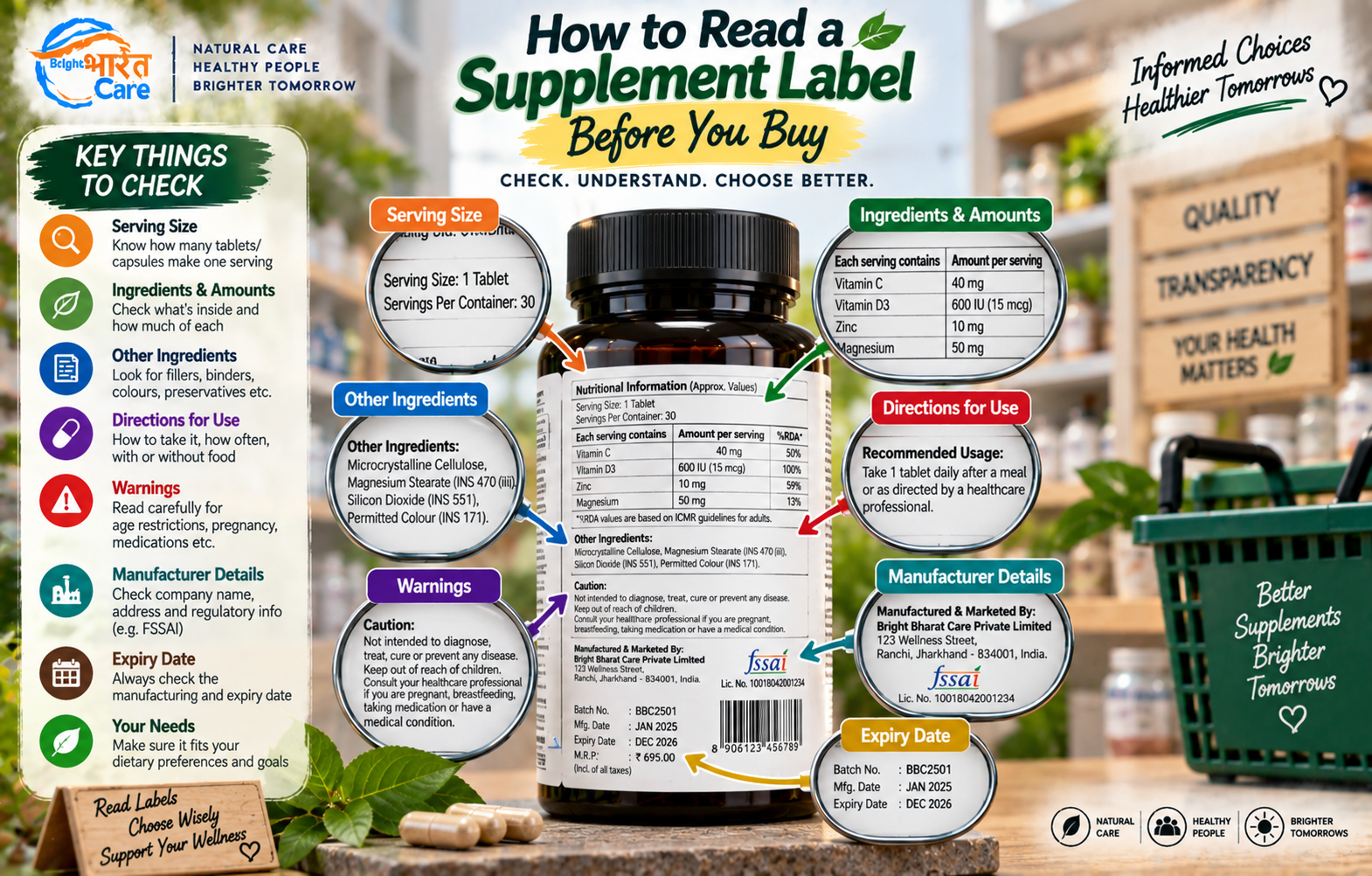
How to Read a Supplement Label Before You Buy
Walk into a pharmacy, browse an online marketplace, or scroll through social media and you will find hundreds of supplements promising different things.
Multivitamins. Minerals. Herbal products. Protein powders. Gummies. Capsules. Tablets.
Their packaging may contain phrases such as:
“High Strength”
“Advanced Formula”
“Daily Wellness”
“Natural”
“Premium”
But attractive packaging doesn’t necessarily tell you whether a supplement is appropriate for you.
Before buying any supplement, one of the smartest things you can do is turn the package around and read the label carefully.
Here are the important things to check.
1. Start With the Exact Product Name
First, understand what you are actually buying.
Two packages may look similar but contain completely different ingredients or strengths.
For example, a product may be:
- A multivitamin and mineral supplement
- A single-vitamin supplement
- A mineral supplement
- A herbal formulation
- A protein supplement
- A combination of several ingredients
Don’t rely only on the biggest marketing words printed on the front.
Read the actual product description.
2. Check the Serving Size
This is one of the most important parts of a supplement label.
A label might list nutrient amounts per tablet, per capsule, per serving, or another specified quantity.
And one serving may contain more than one tablet or capsule.
For example:
Serving Size: 2 Capsules
If you assume the listed amounts apply to one capsule, you could misunderstand how much of each ingredient you would actually consume.
Always ask:
“How many tablets, capsules or scoops make one serving?”
3. Look at the Amount of Each Ingredient
Knowing that a supplement “contains vitamin D” or “contains magnesium” isn’t enough.
You also need to know how much it contains.
Look for quantities expressed in units such as:
mg — milligrams
mcg or µg — micrograms
or other appropriate units.
Remember:
More is not automatically better.
Very high amounts of certain vitamins, minerals or other ingredients may be unnecessary or potentially harmful.
4. Understand % Daily Value or Recommended Intake Information
Depending on the product and applicable labelling requirements, the label may provide information showing how the amount of a nutrient relates to a recommended daily intake or reference value.
This can help put the number into context.
For example, simply seeing:
“Vitamin X — 10 mg”
doesn’t necessarily tell the average consumer whether that amount is small or large.
Reference-value information can make the quantity easier to interpret.
However, your individual requirements can differ depending on factors such as age, sex, diet, pregnancy, health conditions and medications.
5. Read the Complete Ingredient List
Don’t stop after reading the highlighted ingredients on the front.
Check the full ingredient list.
A tablet or capsule may contain active ingredients along with other substances needed for manufacturing, stability, flavour, colour, coating or texture.
Depending on the product, these may include:
- Fillers
- Binders
- Coating materials
- Flavours
- Sweeteners
- Colours
- Preservatives
- Capsule materials
The presence of these ingredients does not automatically mean a product is “bad.”
The important thing is to know what you’re consuming.
6. Don’t Be Distracted by “Proprietary Blends”
Some supplements may list a mixture under a name such as:
“Performance Blend”
“Herbal Complex”
“Energy Matrix”
or another branded combination.
The important question is whether the label clearly tells you what is actually in that blend and, where required or available, the relevant quantities.
A long list of impressive-sounding ingredients is not automatically evidence that the product is effective.
Transparency matters.
7. Check the Directions for Use
Before buying, read how the manufacturer says the product should be used.
Check:
How many tablets/capsules?
How often?
With food or without food?
Is it intended for adults only?
Are there any special instructions?
Do not assume that because one supplement is taken once daily, every supplement should be taken the same way.
8. Read the Warnings
This part of the label is easy to ignore—but it can be very important.
Depending on the supplement, warnings may mention:
- Pregnancy or breastfeeding
- Children
- Medical conditions
- Medication use
- Allergies
- Maximum recommended intake
- Storage requirements
- The need for professional advice
If a warning applies to you, don’t ignore it just because the front of the package looks reassuring.
9. Check for Allergens
If you have food allergies or intolerances, examine the allergen information carefully.
Depending on the formulation, supplements can contain or be manufactured with ingredients derived from:
🥛 Milk
🌾 Wheat
🥜 Peanuts or tree nuts
🌱 Soy
🥚 Egg
🐟 Fish or shellfish
Other allergens may also be relevant.
People with serious allergies should check labels every time rather than assuming a product’s formulation has remained unchanged.
10. Check Whether It Fits Your Dietary Preferences
If you follow a vegetarian, vegan or other specific diet, don’t assume a capsule is suitable just because the ingredients sound plant-based.
Capsule shells and other ingredients can come from different sources.
Look for relevant declarations or symbols on the package and, if necessary, verify the information with the manufacturer.
11. Check the Manufacturing and Expiry Information
Before purchasing, look for the relevant date information.
Check the:
Manufacturing / packing date, where applicable
Best-before or expiry information
Don’t buy a large quantity simply because it is heavily discounted if you are unlikely to use it appropriately before the relevant date.
Also check whether the packaging appears intact.
Avoid products with broken seals, damaged containers or suspicious packaging.
12. Read the Storage Instructions
Supplements don’t necessarily remain suitable under every storage condition.
A label may instruct you to:
Store in a cool, dry place
Keep away from direct sunlight
Protect from moisture
Keep out of reach of children
Some products may have more specific storage requirements.
Follow the instructions printed on the package.
13. Look for Manufacturer and Regulatory Information
Before buying a supplement, particularly online, check whether the label clearly identifies the responsible manufacturer or marketer and provides the regulatory/licensing information required for that type of product in your country.
For products sold in India, the applicable requirements can depend on whether the item is regulated as a health supplement/nutraceutical, Ayurvedic product, medicine, or another category.
Don’t assume every capsule or herbal-looking product falls under the same regulatory system.
Clear traceability is important.
14. Don’t Assume “Natural” Means Risk-Free
The word natural can sound reassuring.
But natural substances can still:
- Cause side effects
- Trigger allergies
- Interact with medications
- Be inappropriate during pregnancy
- Be unsuitable for certain medical conditions
- Be harmful in excessive amounts
“Natural” describes an origin or marketing concept—it does not automatically guarantee safety for every person.
15. Be Careful With Very Big Promises
Treat dramatic claims with caution.
Examples might include:
“Cures diabetes.”
“Melts fat without diet or exercise.”
“Instantly boosts testosterone.”
“Prevents all diseases.”
“No side effects for anyone.”
“Guaranteed results.”
Health outcomes are rarely that simple.
A supplement should not be treated as a substitute for appropriate medical diagnosis or treatment.
16. Check Whether You’re Already Taking the Same Nutrient
This is particularly important when people use several supplements at once.
For example, imagine you take:
A multivitamin
plus
A separate vitamin D supplement
plus
Another “immunity” supplement containing vitamin D
You could be consuming the same nutrient from several products without realizing it.
Always look at your total intake across all supplements, not each bottle in isolation.
17. More Isn’t Always Better
If one tablet contains a useful nutrient, does taking three tablets make it three times better?
Not necessarily.
Some nutrients can cause adverse effects when consumed in excessive amounts.
Fat-soluble vitamins and certain minerals deserve particular attention because excessive intake can be harmful.
Follow appropriate directions and don’t exceed recommended amounts simply because you want faster results.
18. Supplements Don’t Replace a Balanced Diet
The word is supplement for a reason.
For most people, supplements should not become an excuse to ignore the fundamentals of nutrition.
A tablet cannot provide everything you get from a varied diet containing:
🥗 Vegetables
🍎 Fruits
🌾 Whole grains
🫘 Pulses
🥛 Appropriate dairy or alternatives
🥚 Other protein-rich foods
🥜 Nuts and seeds
Supplements can have a useful role in specific circumstances, but they are not a replacement for an overall healthy eating pattern.
Do You Actually Need the Supplement?
This may be the most important question on this page.
Before buying, ask yourself:
“Why am I taking this?”
Is there a diagnosed deficiency?
Has a healthcare professional recommended it?
Is your diet unable to provide enough of a particular nutrient?
Are you taking it because of a specific life stage or dietary pattern?
Or did an influencer simply tell you that everyone needs it?
Different people have different nutritional needs.
You don’t need to buy every trending supplement.
Be Careful When Buying Supplements Online
Online shopping provides convenience—but it can also make it easier to encounter questionable products.
Before purchasing, check:
Who is selling it?
Is the packaging and labelling clear?
Is manufacturer information available?
Are regulatory details present where required?
Are the claims realistic?
Does the price look suspiciously low?
When possible, purchase through trustworthy and traceable sellers rather than unknown sources.
A Simple 30-Second Supplement Label Check
Before you buy, quickly check:
1. Product type
What exactly is it?
2. Serving size
How many tablets, capsules or scoops?
3. Ingredients and amounts
What are you actually getting?
4. Directions
How is it intended to be used?
5. Warnings and allergens
Does anything apply to you?
6. Manufacturer/regulatory information
Can the product be traced appropriately?
7. Expiry and storage
Is the product within date and stored correctly?
8. Claims
Do they sound realistic or exaggerated?
Those few seconds can help you make a much more informed decision.
Don’t Choose a Supplement Only Because of the Front Label
The front of the bottle is advertising space.
The back of the bottle is where you often learn much more about what you’re actually buying.
A premium-looking package, celebrity endorsement or huge headline does not automatically tell you:
Whether you need it.
Whether the dose is appropriate.
Whether it interacts with your medicines.
Whether the claims are well supported.
Learn to turn the bottle around.
When Should You Ask a Healthcare Professional?
Professional guidance can be particularly important if you:
- Take prescription medicines
- Have a chronic medical condition
- Are pregnant or breastfeeding
- Are considering supplements for a child
- Take multiple supplements
- Have known nutrient deficiencies
- Have kidney or liver problems
- Have significant allergies
- Are considering high-dose supplementation
- Are experiencing symptoms you are trying to self-treat
A supplement should not delay appropriate diagnosis or medical treatment.
The Bottom Line
Don’t buy supplements based only on attractive packaging or impressive promises.
Before purchasing, check:
🔎 What is actually inside
📏 How much each serving contains
💊 How it should be taken
⚠️ Warnings and allergens
🏭 Manufacturer and regulatory information
📅 Expiry and storage
📢 Whether the claims are realistic
And most importantly:
Ask whether you actually need the supplement in the first place.
Being an informed consumer is more valuable than owning the most fashionable bottle on the shelf.
A Question for You
When you buy a supplement, what do you check first—the ingredients, dosage, price, brand, reviews, or expiry date? 💊
Share your answer in the comments below. 💚
— Bright Bharat Care
This article is for general educational purposes only and does not provide individualized medical or nutritional advice. Supplements can cause side effects and interact with medicines. Seek advice from an appropriately qualified healthcare professional when needed.






One comment
ABHINAV BHARDWAJAuthor
Thank you for reading! 💊🌿 At Bright Bharat Care, we believe that choosing a supplement should begin with understanding what you are actually buying. Taking a few moments to check the ingredients, serving size, directions, warnings, expiry date and manufacturer information can help you make a more informed choice instead of relying only on attractive packaging or marketing claims. We hope this guide helps you become a more aware and confident consumer. What do you usually check first when buying a supplement—the ingredients, dosage, brand, price or expiry date? Share your thoughts in the comments below! 💚
— Team Bright Bharat Care